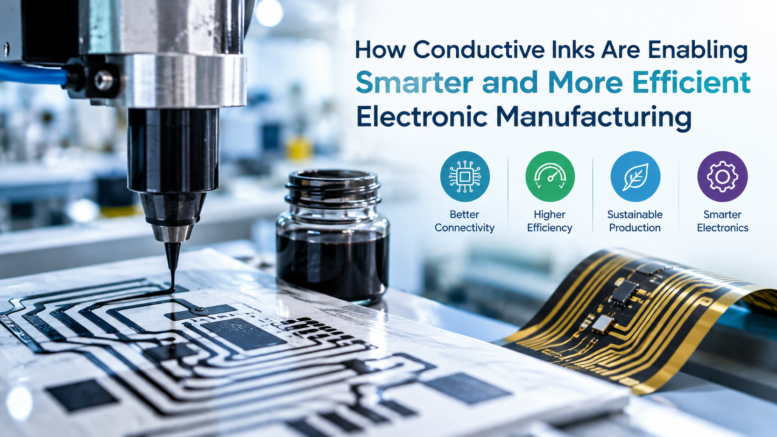
The growing developments in the electronics industry are causing a demand for innovative materials which provide the combination of electrical capabilities and an efficient manufacturing process. Conductive inks are solving this problem by allowing electrical circuits, sensors, antennas, and other elements to be printed on plastics, films, papers, glasses, and even textiles. With the help of conductive inks, the possibilities of screen printing, inkjet printing, and gravure printing are used to make electronics thinner, lighter, flexible and more integrated. In addition, the increasing demand for uses of conductive inks has been playing an important role in the growth of the conductive inks market in the sectors of printed electronics, flexible displays, RFID devices, automotive industry, wearable electronics, and smart packaging.
How Conductive Inks Transform Electrical Manufacturing
Since the conductive inks help print electrical circuits on various surfaces directly without using wires, it has been possible for manufacturers to produce small and light-weighted electronic components.
From Conventional Wiring to Printed Electronic Pathways
Classic electronic manufacturing involves the use of separately fabricated parts, etching, and assembling to generate the conductive paths. This can be replaced with the use of conductive inks, which provide an option for generating electrical paths through printing techniques. The use of inks containing materials like silver, copper, and others can generate circuits and other electrical components using printing techniques. This method makes it possible for electronic functions to be realized on substrates that might not be amenable to conventional wiring techniques. The technology is especially applicable to flexible electronics and can be used to incorporate conducting paths along curved or irregular surfaces with more flexibility in design.
Key Materials and Printing Techniques Involved in Conductive Ink Formation
The choice of conductive material and printing method plays an important role in determining the performance, precision, and scalability of printed electronic components. Various materials and methods provide their own set of strengths, depending on the use and substrates and needed conductivity.
- Silver-Based Conductive Inks: Ideal where conductivity is critical, such as in printed circuits and electrodes.
- Copper-Based Conductive Inks: Great conductivity and can replace expensive silver ink; but oxidation is an issue.
- Carbon-Based Conductive Inks: Where there is a need to achieve balance between conductivity and flexibility.
- Graphene-Based Conductive Inks: Ideal for novel uses in flexible electronics and printed electronic devices.
- Screen Printing: Relatively high ink loading can be achieved and is appropriate for manufacturing conductive films that have relatively high thickness.
- Inkjet Printing: Enables precise, digitally controlled conductive patterns without requiring physical printing plates.
- Gravure Printing: Supports high-speed production of fine and consistent conductive patterns for large-volume applications.
- Flexographic Printing: Enables continuous deposition of conductive inks on flexible substrates for scalable production.
Design Possibilities for Thin, Lightweight and Flexible Electronics
Electrical ink technology is opening up new opportunities for electronics that need to function within thin, lightweight or flexible form factors. Printed pathways can be directly printed on polymer films, fabrics, paper, glass, and other materials, and thus electrical functions can become an integral part of the product surface without being limited only to the rigid circuit board. Such an ability opens up opportunities for various applications, including flexible sensors, wearables, smart labels, antennas, touch screens, and printing heaters. It becomes possible to incorporate several electronic functions in relatively small surfaces of the product.
Applications Across Next-Generation Electronics
Electronic functions can be enabled on different surfaces by means of conductive ink. Conductive ink is being increasingly employed for circuits, sensors, antennas, displays, packaging, and connectivity in devices through sophisticated printing technology.
- Conductive Tracks, Electrodes, Contacts, And Sensors in Flexible and Printed Electronics
Conductive inks are widely used for the formation of conductive tracks, electrodes, contacts, and sensors in flexible and printable electronics. Conductive tracks produced by printing can be used for applications such as temperature, pressure, touch, movement, and chemical sensing. Conductive inks may also be deposited on polymers, fabrics, and other materials to form flexible devices which can adhere to surfaces. The formation of printed circuits and interconnections is possible using conductive inks through material deposition. Printing methods give manufacturers more flexibility when it comes to design of circuitry.
- Smart Packaging, RFID and Connecting Devices
Conductive inks allow packaging to integrate ID, sensing, connection, and interaction into light-weighted substrates. Such properties facilitate applications like supply chain management, product authentication, stock control, and customer interaction.
- Electronic Identification: Conductive ink facilitates the incorporation of electronic tracking and connectivity functions within the packaging itself.
- RFID Tags: Through conductive ink, RFID tags can be printed in such a way that they facilitate communication with compatible scanners.
- Interactive Packaging: The conductive ink may be able to create printed switches, interactive features, etc., which may link tangible products with the digital information system.
- Lightweight Electronics: Their use in paper, film, labels, and other packaging materials may allow for electronic capabilities without heavy parts.
- Supply Chain Applications: The conductive ink may be able to help in product authentication, inventory control, supply chain management, and consumer interaction.
- Automotive, Wearable, And Energy-Based Electronics
Conductive inks are finding new applications in automotive, wearable technology, and energy sectors through the provision of electronic functions on light and flexible substrates. The capability of forming printed paths of conductivity is useful in creating novel electronic devices.
- Automotive Applications: Antenna sensors, heating elements, touch screen displays, and other printed electronics components.
- Wearable Applications: Helps in creating pathways on textiles, sensors, biometric sensors, and conformable electronics.
- Energy Applications: Helps in the fabrication of electrodes, current collectors, and other conductive components for advanced energy devices.
Driving Smarter and More Efficient Production
Electronics fabrication can be enhanced through conductive inks because material deposition, digital design, and printing can be combined. Through selective deposition, precise material utilization can be achieved while complex designs and electronic component fabrication can be achieved.
- Focusing on Additive Printing Processes to Streamline Manufacturing
The use of conductive inks would allow manufacturers to streamline manufacturing processes by performing both material deposition and pattern creation through printing process techniques. It allows for defining conductive lines through digital means and replicating the same across multiple units using defined placements. This would allow for consistent manufacturing of the devices. Programmed printing techniques can help in changing designs rapidly without any adjustments to tools, which could be essential in cases where different circuit designs have to be used in products. Screen and rotary printing techniques offer additional ways of scaling up production in a repeatable manner.
- Precise Material Reduction with Conductive Deposition
Material economy is yet another dimension in which conductive ink can aid the manufacture of electronic products. By printing, conductive materials can be placed only on those regions where they are required instead of being put all over the substrate and then discarding the parts which are not desired. Such precision can aid in controlling the amount of materials used in appropriate production methods. Moreover, it enables electronic components to be printed on thin films, flexible substrates, textiles, and other surfaces. In addition to deposition and curing techniques, such capabilities help manufacturers to control the use of materials according to their production needs.
Enabling the Next Era of Printed Electronics through Powering
There is increasing significance of conductive inks as enabling materials for making electronic products owing to the capability of directly printing circuits or other functional components on various substrates. The use of these inks enables the production of flexible electronics, sensors, antennas, smart packaging, displays, and other printed electronics. The compatibility of conductive inks with modern printing methods such as screen printing, inkjet printing, gravure printing, and flexographic printing makes it possible to incorporate electrical functionalities on plastics, films, paper, glass, fabrics, and other surfaces. Conductive inks market has increasing relevance to manufacturing applications requiring custom design, material deposition efficiency, and electrical functionality due to advancements in printing technologies.
According to Pristine Market Insights, further advances in the formulations of conductive ink, as well as advances in printing techniques, will likely increase the applicability of conductive ink for new electronics applications. Increased conductivity, improved adhesion, curing, flexibility, durability, and improved substrates are among the possible areas of improvement to meet varying requirements. Meanwhile, the use of digital and automated printing will allow for increased production flexibility and precise deposition of conductive materials. This is important in light of the current trend of producing electronics that are increasingly becoming thinner, lighter, flexible, and more integrated. In this way, conductive inks may become part of developing electronic devices with functionalities as well as adaptability and scalability of manufacturing.
Author Bio:
Teja Kurane is a research analyst at Pristine Market Insights, focusing on advanced materials, electronics, and emerging manufacturing technologies. Teja examines how innovations such as conductive inks, printed electronics, and smart manufacturing solutions are influencing production processes, improving efficiency, and supporting the development of next-generation electronic devices and components
Be the first to comment on "How Conductive Inks Are Enabling Smarter and More Efficient Electronic Manufacturing"