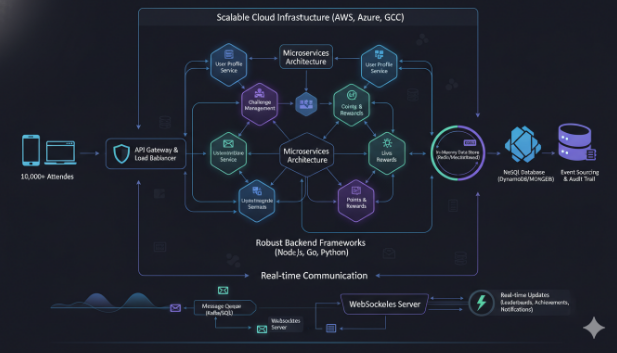
Running gamification at a small event is one thing. Running it smoothly when 10,000 or more people are all playing, competing, and checking leaderboards at the same time is a completely different challenge. The stakes are higher, the load on your tech is heavier, and the margin for error is almost zero. A single glitch during a live leaderboard update or a quiz round can break the energy of an entire hall in seconds. That is why gamification at scale is not just a creative decision. It is a technical one. The mobile event app sitting at the centre of your gamification strategy needs to be built for this kind of pressure. Here is what that looks like in practice, and why it matters more than most organisers realise until it is too late.
What Is Gamification And Why Does It Matter At Large Events?
Gamification simply means bringing game-like elements into a non-game setting. At events, this usually looks like points, leaderboards, badges, quizzes, challenges, and rewards that encourage attendees to participate more actively. Instead of sitting passively through sessions, attendees are checking in to earn points, visiting sponsor booths to unlock rewards, answering trivia questions between talks, and competing with others on a live leaderboard.
At smaller events, this works well even with basic tools. But at large-scale events with tens of thousands of attendees, the experience needs to scale with the crowd. When 10,000 people are all interacting with the same platform at the same time, the system handling it needs to be robust enough to process all of that simultaneously without lagging, crashing, or showing outdated data. This is where most generic tools fall short and where purpose-built event technology becomes essential.
Where Dreamcast Comes In?
Dreamcast has powered gamification at some of India’s largest events, from large-scale conferences to mega exhibitions with hundreds of thousands of attendees, and that experience shows in the reliability of the platform. When your event registration system, event ticketing platform, event check-in system, and onsite event badges all work as part of the same ecosystem, gamification becomes something your attendees genuinely enjoy rather than something that just about holds together on the day.
Dreamcast’s Event App: The Best Way To Ensure Glitch-Free Gamification
The mobile event app is the engine that makes gamification work at scale. Everything runs through it. Points get tracked, leaderboards update, challenges get completed, and rewards get claimed, all inside the app. For this to work without hiccups when the crowd is massive, the app needs to do several things very well. Dreamcast’s app does all of this:
It needs to handle simultaneous load without slowing down:
When 10,000 attendees all open the leaderboard at the same moment after a big announcement, the app cannot freeze. Dreamcast’s mobile event app is built and stress-tested for exactly this kind of load. With a proven track record at events ranging from 50,000 attendees to mega-scale events crossing 5 lakh participants, the platform is designed to stay stable when demand spikes suddenly and without warning.
It needs to update in real time:
Nothing kills the excitement of a leaderboard faster than scores that are 10 minutes behind. Real-time sync across thousands of devices is a hard technical problem, and it is one that the right event app solves quietly in the background. Attendees should see live rankings the moment they update, not a cached version from earlier in the day.
It needs to connect with the broader event tech stack:
Gamification does not live in isolation. Points might be earned by checking in at a session, which connects to the event check-in system. Rewards might be tied to visiting specific booths, which connects to RFID tracking. Leaderboard entries might require scanning onsite event badges at designated points across the venue. When the mobile event app is part of a fully integrated platform that also covers event registration solutions, ticketing, check-in, and badging, all of these connections work naturally. When it is a standalone tool patched into other systems, the connections become the weak points.
It needs to support multiple types of gamification simultaneously:
A large event might have a photo contest, a quiz, a scavenger hunt, and a points-based leaderboard all running at the same time for different audience segments. The app needs to manage all of these without confusion, keeping each experience clean and separate for the attendees participating in them.
It needs to work even in low-connectivity environments:
Large venue halls, basements, and exhibition spaces are notorious for patchy internet. A well-built event app accounts for this with offline functionality that syncs when connectivity returns, so no points are lost and no progress disappears just because someone was in a dead zone for a few minutes.
It needs to give organisers live visibility:
While attendees are playing, the organising team needs to be watching. Real-time dashboards showing participation rates, active users, top scorers, and engagement by zone help the team make quick decisions. If a particular game is not picking up traction, they can push a notification to nudge attendees. If a sponsor zone is getting too crowded, they can reroute traffic. This kind of on-ground decision-making is only possible when the app is feeding live data back to the team continuously.
Conclusion
Gamification is one of the most powerful tools an event organiser has for keeping a large audience engaged, energised, and connected throughout an event. But at the scale of 10,000 or more attendees, it only delivers on that promise if the technology behind it is solid. The mobile event app is where it all lives, and it needs to be built for the pressure that comes with a massive crowd.
Be the first to comment on "Managing Gamification for 10,000+ Attendees Without Glitches: Key Tech that Helps"