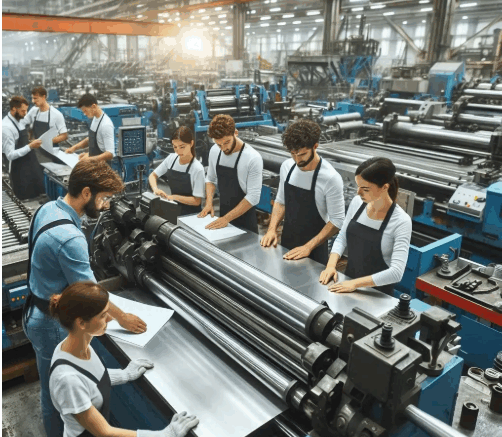
Automatic plate rolling machines have become an essential development in the contemporary metal fabrication industry to mechanically roll metal plates into cylindrical, conical, or curved shapes without any variability in the process or end product. These machines are widely used in manufacturing industries, including shipyards, pressure vessels, steel fabrication, wind energy, and automotive fabrication. Automated, programmable controls and hydraulic or CNC functions provide consistency and efficiency in the rolling process for these machines.
What is an Automatic Plate Rolling Machine?
An automated plate rolling machine is an industrial machine used to bend and forming flat sheets of metal into cylindrical or curved-shaped components without human intervention. Compared with a conventional manual roller, an automated machine will be equipped with either a programmable logic control (PLC) or a CNC to carry out the feed rate, application of pressure, and position of the rolls, usually under the control of someone observing the process. The automated machine can provide an even curvature, decrease material waste, and have higher throughput than the manual alternative.
Working Principle of Automatic Plate Rolling Machines
An automatic plate rolling machine has the need for three or four rolls that work together to perform the process of rolling. The two lower rolls contribute to feeding and holding the plate, while the upper roll(s) are engaged in applying the pressure needed to curve the plate. Once the operator indicates the desired diameter and bend or curvature on the control panel, the machine positions the rolls, and the rolling takes place; in multiple passes, the machine will repeat this process. Some high-end models have rolls that are actuated by hydraulic or electric opportunities for a different degree of accurateness and improved consistency during the process. By automating the process, it reduces the need for viewing and lowers the risk of error from manual handling the previously mentioned tiller.
Key Features and Components
Modern plate rolling machines offer advanced features that enhance precision, efficiency, and ease of operation. The CNC or PLC control system allows for precise programming and repeatable rolling accuracy. The hydraulic drive system delivers consistent pressure and allows for steady bending of even the thickest metal plates. The pre-bending function reduces the width of the flat edge of the metal plate to ensure even higher accuracy in rolling and produces parts with better quality.
Automatic feeding and ejection functions are convenient because they streamline the procedure and promote safety for operators by minimizing heavy handling. Modern day digital displays and sensors can monitor operations, such as bending force, roll position, and plate thickness, in real time allowing for greater process control and reliability.
Advantages of Using Automatic Plate Rolling Machines
Automatic plate rolling machines provide many benefits that make them popular in modern-day fabrication industries. They combine precision and consistency with automated control systems, providing uniform bending and low chances of human error. Because they also reduce setup times and plates produced per hour, they produce higher levels of productivity and efficiency. With pre-bending accurate to within ten degrees, you save excess material, resulting in cost savings. With great safety features, you spend less time involved in processes that put you in harm’s way. Their versatility allows the manufacturers to not only roll a variety of materials (i.e., stainless steel, carbon steel, aluminum) at a variety of thicknesses, but makes them suitable for varied industrial purposes.
Industrial Applications
Automatic plate rolling machines play a vital role across a wide range of industries by enabling precise and efficient metal forming. In the shipbuilding sector, they are essential for fabricating hull sections and curved ship panels with uniform curvature. The pressure vessel manufacturing industry relies on these machines to create boilers, storage tanks, and pipelines with high strength and accuracy. In wind energy production, they are used to roll large steel plates for turbine towers. The construction field takes advantage of their capacity to form beams, steel constructions and architectural elements. In automotive and aerospace sectors, they provide reliable and accurate shaping of parts that make up structural and body components while satisfying the detailed quality and performance requirements of the industry.
Maintenance and Safety Concerns
Regular upkeep is critical for providing reliable long-term operation. Operators need to check the hydraulic system, lubricate moving parts, and check that all rolls are lined up. Any safety features, including emergency stops, overload protection, and shutdown devices, have to work correctly every time you use the equipment so that conditions are as safe as possible.
Conclusion
The automatic plate rolling machine is an ideal combination of precision engineering and automation. Not only does it improve the process of metal forming, but it also increases productivity, accuracy, and safety of operation. As businesses continue to demand faster and more reliable products, the utilization of automatic plate rolling machines will be an important factor in all quality manufacturing processes.
Be the first to comment on "Automatic Plate Rolling Machine — Enhancing Precision and Efficiency in Metal Forming"